Unit limits, and the indicator that decides your next move
Every code carries a maximum number of units payable, and a second value saying how that maximum is enforced. The second one matters more: it decides whether the excess is recoverable on another line, recoverable on appeal, or gone.
The three enforcement types
| Indicator | What it means for the excess units |
|---|---|
| MAI 1 | A per-line edit. The limit applies to each line, so genuinely furnished units above it can go on a separate line with an appropriate modifier. |
| MAI 2 | A date-of-service edit, and absolute. The excess is not payable and not appealable. Splitting across lines does not work — the edit sums the date. |
| MAI 3 | A date-of-service edit, but appealable. The excess can be paid where the units are correctly coded and medical necessity is documented. |
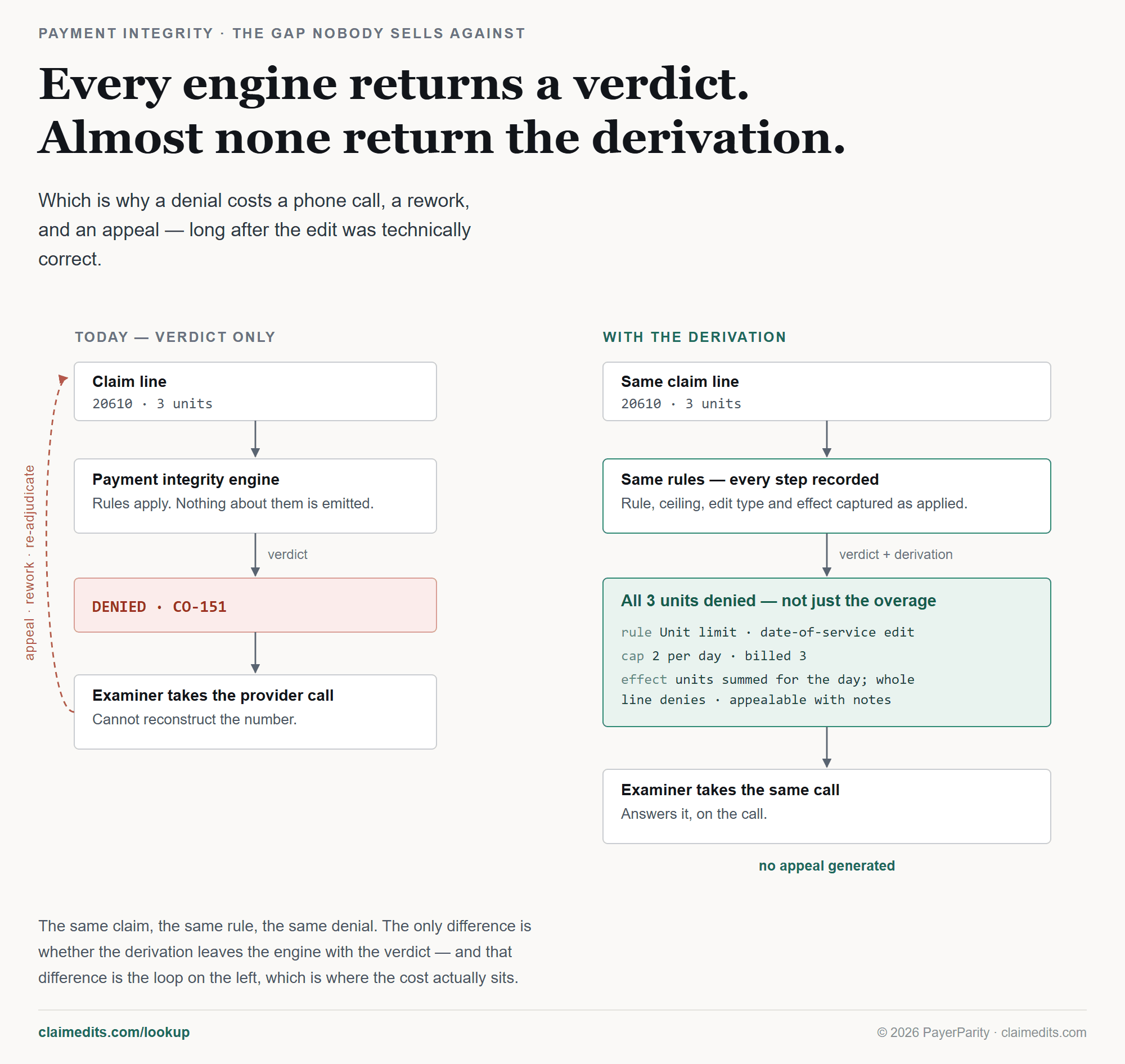
Why the second claim denies too
The instinct on a units denial is to split the quantity across two lines and resubmit. Against MAI 1 that is correct. Against MAI 2 or MAI 3 it is wasted work: those edits apply per date of service, so two lines of four are the same eight units the edit already rejected. Appending a distinct-service modifier does not help either — units and bundling are separate questions.
For MAI 3, the route is documentation and an appeal, not a resubmission. For MAI 2, there is no route; the correct action is to bill the maximum.
The limit depends on who is billing
The same code carries different maximums for practitioner claims, outpatient hospital claims and DME suppliers. Checking a practitioner claim against the outpatient hospital table produces a confident wrong answer, so the setting has to be part of the question.
Medicaid publishes its own limits
Medicaid maintains a separate set of unit limits, and they differ from Medicare on thousands of codes — sometimes higher, sometimes lower. The Medicaid files also do not publish the enforcement indicator, so where a Medicaid limit differs, whether the excess is appealable is genuinely unknown rather than assumed. More on where the two programmes diverge.
On a remit
A unit limit breach usually arrives as CO151 — the information does not support this many services. If CO151 appears and no published limit is exceeded on the claim, the payer applied a limit of its own, which is an appeal rather than a correction.
Check it against your own claim
Reading about the rule is not the same as knowing whether it fires on the codes in front of you. The checker answers that against the policy in force, and says what would clear it.
Check units on a claim