Why a claim with no denials still pays less than the fee schedule
Edits decide whether a line survives. Reductions decide what a surviving line is worth, and they leave no denial code, no remark and nothing on the remit that says reduced. The money simply arrives smaller.
Nothing is denied, and the claim still shrinks
Two surgeries in one session. There is no bundling pair between them, both are within their unit caps, neither needs a modifier and no appeal will ever be filed. Every edit passes. The lesser procedure is still cut in half, because after the edits clear the lines are ranked by their allowed amount and the subsequent one pays at fifty per cent.
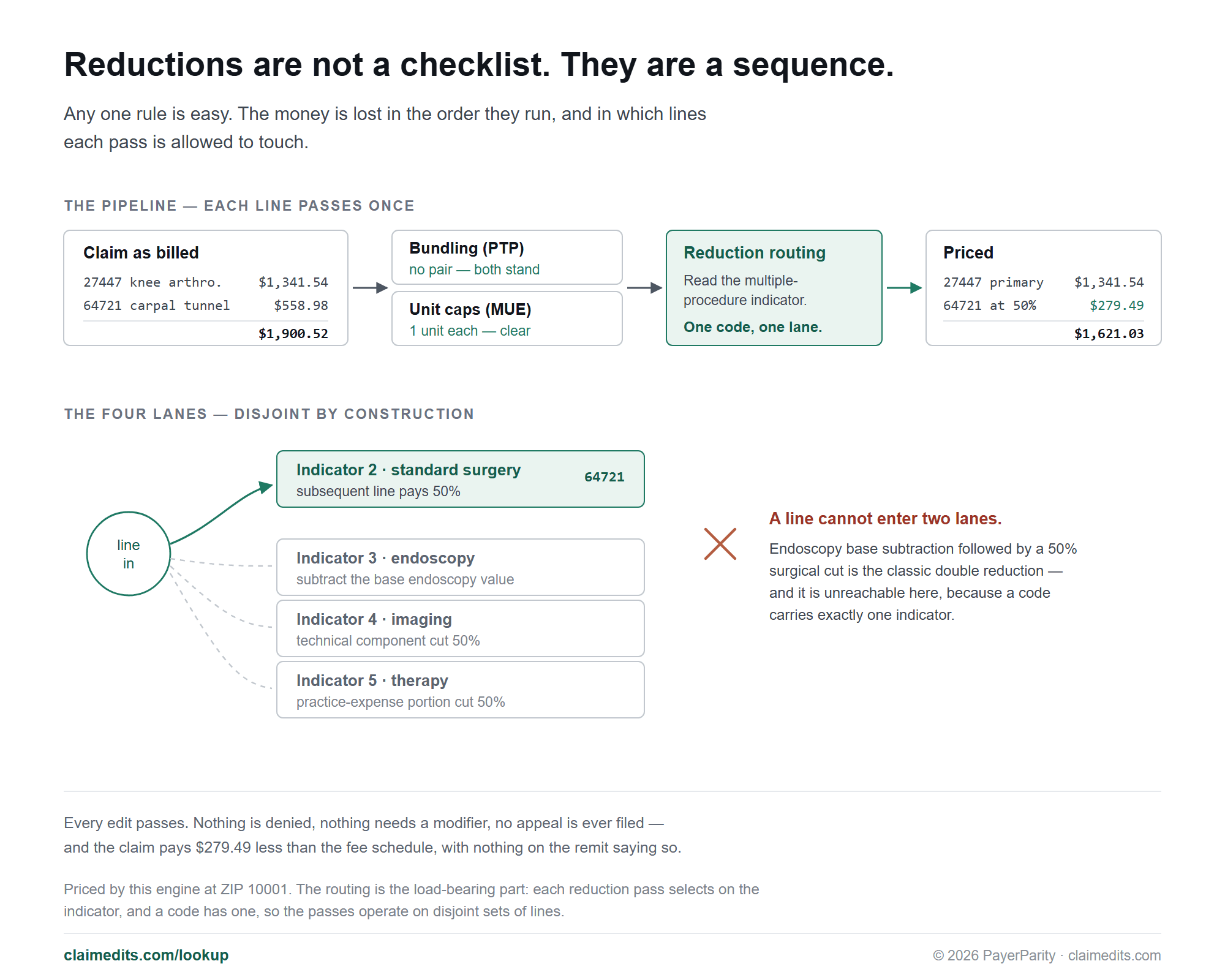
Four reductions, and a line qualifies for at most one
| Indicator | What the reduction does |
|---|---|
| 2 — standard surgery | Lines are ranked by allowed amount. The highest pays in full; each subsequent line pays 50 per cent. |
| 3 — endoscopy | Not a percentage. The subsequent scope pays its own value less the value of the family's base endoscopy. |
| 4 — imaging | The technical component of the subsequent study is cut 50 per cent. The professional component is untouched. |
| 5 — therapy | Only the practice-expense portion of the subsequent service is reduced, which is why the result is never a clean half. |
The defect this ordering prevents
The classic error is to subtract an endoscopy base value from a line and then take a fifty per cent surgical cut off the same line. It reads as two rules correctly applied, and it produces a number far below what the claim is owed.
It cannot happen here, and not because anyone remembered to guard against it. The indicator is a single value on the code, so a line that enters the endoscopy lane is not eligible for the standard surgical lane at all. The lanes are disjoint by construction rather than by convention.
Why the order matters more than the rules
Any one of these reductions is easy to state. Reviews of this logic usually check whether each rule is right, and each rule usually is. What moves the money is the sequence they run in and which lines each pass is allowed to touch — reductions are applied after the edits resolve, on the lines that survived, ranked by what those lines are worth.
On a remit
This is the part that makes reductions expensive to audit: there is no code for them. A bundling denial arrives as CO236 and a unit breach as CO151, each of them a thread you can pull. A multiple-procedure reduction produces neither. The line is marked paid, at a number nobody explained, and the difference is only visible to someone who already knew the fee schedule amount.
Check it against your own claim
Reading about the rule is not the same as knowing whether it fires on the codes in front of you. The checker answers that against the policy in force, and says what would clear it.
Price a claim